
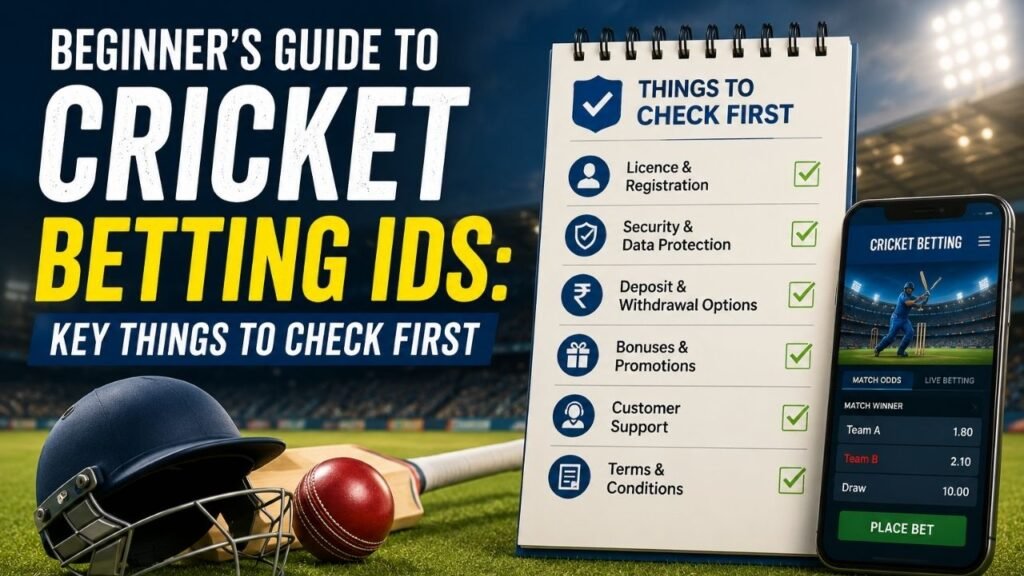

In the past few years, cricket betting has grown exponentially in popularity, and so it should — cricket lends itself very nicely to being bet on, so it’s easy to see why. Without a doubt, the sport provides a remarkable amount of drama, unpredictability, and passion — all components that make betting truly exciting. However, if you are a novice learner, then the process of creating an account, i.e., cricket betting ID, can be tedious.
Where do you even begin? What should you look for? What is some advice people wish someone else had given them before they got started?
So this guide is here to help you with all of that. Like your playlist, the list of things to be taken care of will assist you in ensuring that you engage in something worthwhile before creating your first cricket betting ID and placing bets on matches.
What Exactly Is a Cricket Betting ID?
Which brings us back to the beginning. A cricket betting ID is basically your registered account on a particular betting site, allowing you to play betting and gambling on the platform. That is how you build your identity on this platform: link to your email ID, mobile number, payment options, and betting history.
Similar to a casino ID that allows you to play various games and bet on multiple features of a casino platform, A cricket betting ID gives you access to all the betting markets, live odds, and features available in a cricket sportsbook. If not, you can browse but cannot play along.
This makes getting that right from day one more significant than many beginners grasp.
Step 1: Choose a Licensed and Regulated Platform
The one most crucial non-negotiable item on your checklist.
Confirm that the platform you are signing up with has a license from a credible gambling authority before you input even one piece of personal information. Legitimate platforms will make their licensing information readily available usually in a footer on the website or an About or Legal page.
Why does this matter so much? In any case, a licensed platform is obliged by law to comply with the highest security standards regarding fair play, your data, and financial transparency. In the event of anything going awry with a disputed bet, say, or a withdrawal issue, you have an institution whose impartial authority you can only turn to. This means that you are your only support when using an unlicensed site.
Search for licenses from regulatory entities such as the Malta Gaming Authority (MGA), the UK Gambling Commission, or Curaçao eGaming. These are well-respected and push platforms to perform at their best.
Step 2: Check the Registration Requirements
Each platform has its own registration process, there are a few things that are fairly standard across the board.
You’ll typically need to provide:
- One of these restore points is a legitimized government ID (legitimate Government Issued ID) travelling computer, a driving license, or a public ID, Morgan
- Proof of residence (usually a utility bill or bank statement works)
- An email address and phone number that are still in use
- Date of birth- platforms need to confirm you’re old enough
Additionally, some platforms require further verification before allowing you to withdraw, so having these documents prepared in advance is a great idea. It is really frustrating to be halfway through a withdrawal and then get asked for documents that you cannot provide on the spot.
Step 3: Understand the Available Cricket Markets
When you get in, you’ll quickly realize that cricket gambling is way more than simply about determining which team will win the game. You have an entire universe of betting markets.
The following are among the most widely used ones:
- Match winner – The simple one. Who wins the game?
- Top Batsman/Top Bowler Who gets the most runs/wickets?
- Total Runs – Total runs a team scores over or under a number.
- Series WIn State – Who wins over a series of matches?
- Live Betting – This allows a bettor to place bets during the timeout with live odds that change right as time passes.
If you are a rookie, I encourage you to stick with the simplest markets while learning the ropes. In particular, live betting can be an exhilarating experience, but it’s also where the novice sports bettor is prone to making hasty emotional decisions. Master the game, learn the odds, and climb your way to the top.
Step 4: Look at Deposit and Withdrawal Options
Take a few minutes to familiarize yourself with your platform’s banking options prior to funding your account. These comprise deposit techniques, limits of minimum amounts and maximums, processing times, and any applicable fees.
You are trained to accept payments in a variety of methods — debit/credit cards, bank transfers, e-wallets (PayPal or Skrill), and now UPI and other local options based on your region.
Watch out for withdrawal windows. Now, some platforms payout in 24 hours (like Fold), while others can take a few business days. If access to your money quickly is a big consideration for you, it might be worth looking at this before you commit.
At the same time, pay attention to the welcome bonus wagering requirements. Deposits and free bets will obviously catch your attention, but they also often have caveats – such as having to bet a certain amount in order to withdraw any bonuses earned.
Step 5: Examine the Bonus as well as the Promotions Policy
Speaking of bonuses, they are one of the stuff that platforms use to attract new users and can add value as long as you understand them correctly.
Common types of bonuses include:
- Welcome bonuses – generally a match deposit or free bets available at sign-up
- Reload bonus – Provided for deposits made after the first one in order to keep you interested
- Improved Odds – Boosted odds for selected matches or events for a limited time.
- Cashback deals – If your bet loses, you may receive a partial refund
The key is to read the terms. It depends on the minimum odds, how early you have to use it, and whether it is for all games or one specific game.
Step 6: Test Customer Support Before You Need It
This is one that beginners usually overlook, but it is really good advice. Test the platform’s support system while the stakes are low, before you find yourself in a situation where you’re pressing needs help as quickly as possible.
Just ask a simple question in the live chat or email. See how quickly they respond. See if the responses were useful (and really human) or just carbon-copied from an FAQ.
It is the good customer support that can tip the balance when you are faced with a delayed payment or an unsuccessful technical transaction in the course of live betting. Platforms that actually care about their end-user experience tend to be the ones that invest in good support.
Step 7: Set Your Limits From Day One
This is the part that most beginners miss out on – and arguably, so it should be the habit you build right early on.
Establish a budget before making your first bet. How much are you okay with spending in 1 week or a month? If available, set deposit limits, loss limits, and session time reminders (most licensed platforms offer these).
Responsible betting doesn’t have to be boring – it just needs to ensure that the hobby remains fun in the long run. And so, the same principle should apply while you manage a cricket betting ID (best to lose) or a casino ID: entertainment within limits (not losing).
Final Thoughts
Cricket betting is not that hard, just needs groundwork. It is important to choose the right platform. The way your ID works within the laws of equity that ensure awareness of all players – knowing the markets and setting sensible limits is half the win!
Spend some time on every step with this checklist, and you will be in a better position than the majority of newbie bettors who simply create an account without any research whatsoever and jump in head-first – cricket is a game of patience, even with your betting strategy to!